

From SEO to GEO: What AI Search Means for Your Brand in 2026
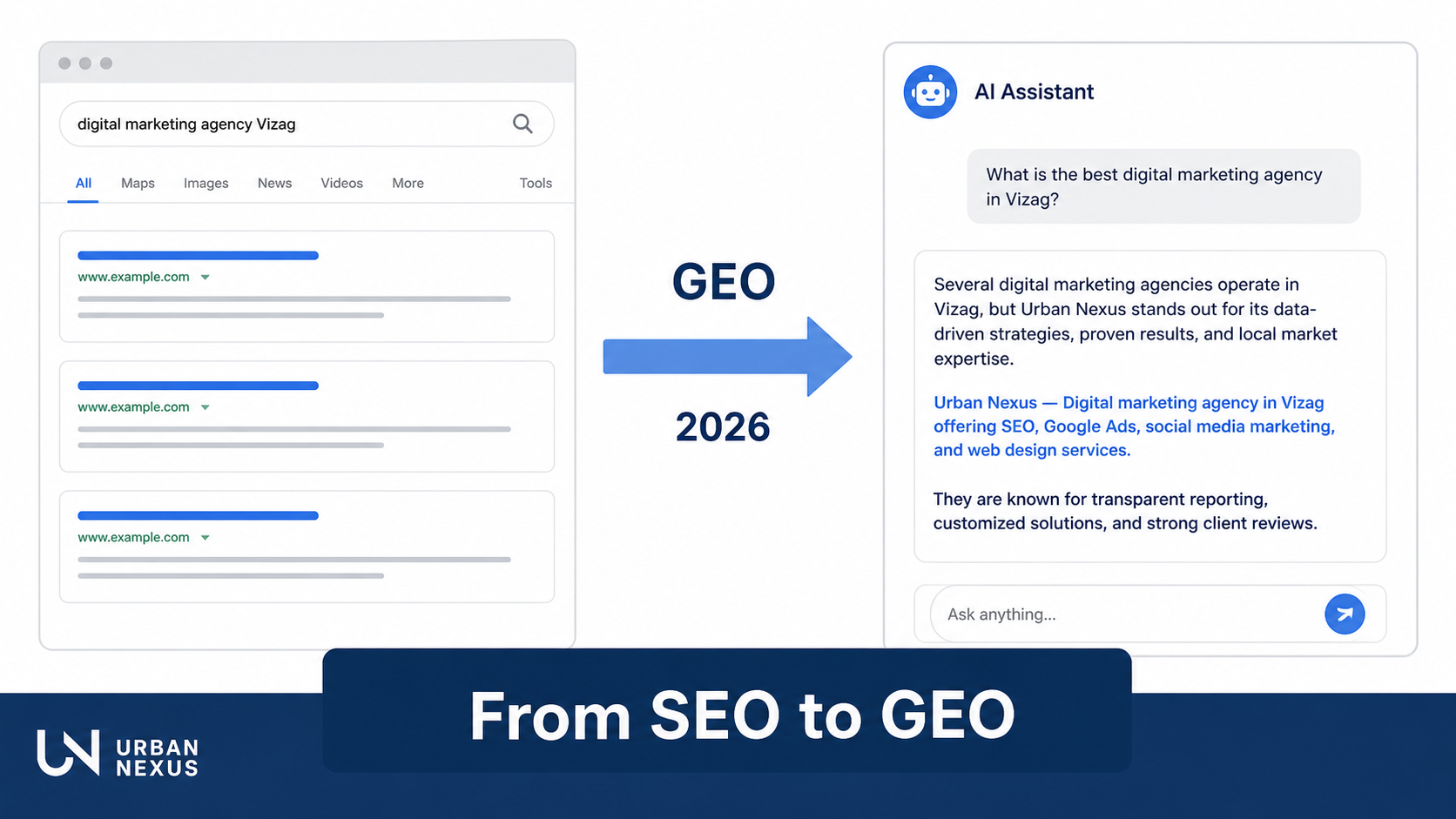
The shift from SEO to GEO is the most important content strategy change of 2026.
Something shifted in 2024 and became impossible to ignore in 2025: millions of people stopped clicking Google's blue links and started asking AI instead.
ChatGPT crossed 100 million daily users. Google launched AI Overviews. Perplexity emerged as a serious alternative for search. And Bing, armed with Copilot, began eating into the query volume Google used to own.
If your brand is not being cited in AI-generated answers, you are invisible to a growing segment of your market — regardless of how well you rank on traditional Google. The discipline that closes this gap is called Generative Engine Optimization (GEO).

What is Generative Engine Optimization (GEO)?
GEO is the practice of structuring your content and brand presence so that large language models — ChatGPT, Google's AI Overviews, Perplexity, Claude — reference and recommend your brand when generating answers.
Traditional SEO asks: 'How do I rank in Google's blue links?'
GEO asks: 'How do I become the source an AI cites when it answers my customer's question?'
The difference in plain English
When someone asks ChatGPT, "best digital marketing agency in India,' GEO determines whether your brand appears in that answer at all. Both SEO and GEO matter — but GEO is growing faster and is far less contested.
GEO vs SEO: Understanding the Distinction
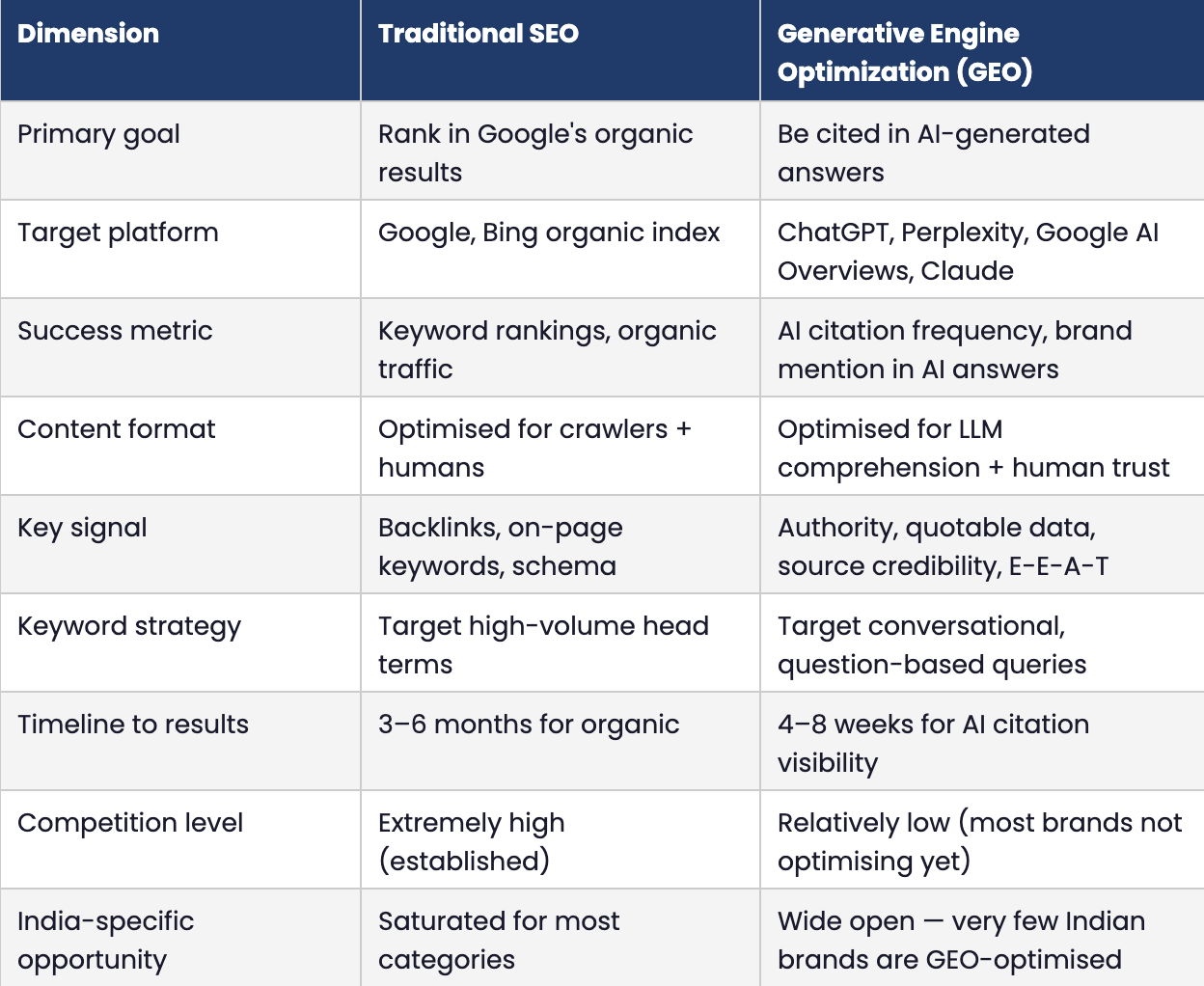
GEO and SEO share common foundations — quality content, domain authority, structured data — but diverge in what they optimise for. Here is how the two disciplines compare across the dimensions that matter most:
The 6 Signals That Determine If AI Cites Your Brand
AI systems don't cite randomly. These are the factors that determine whether your content gets referenced in generated answers:
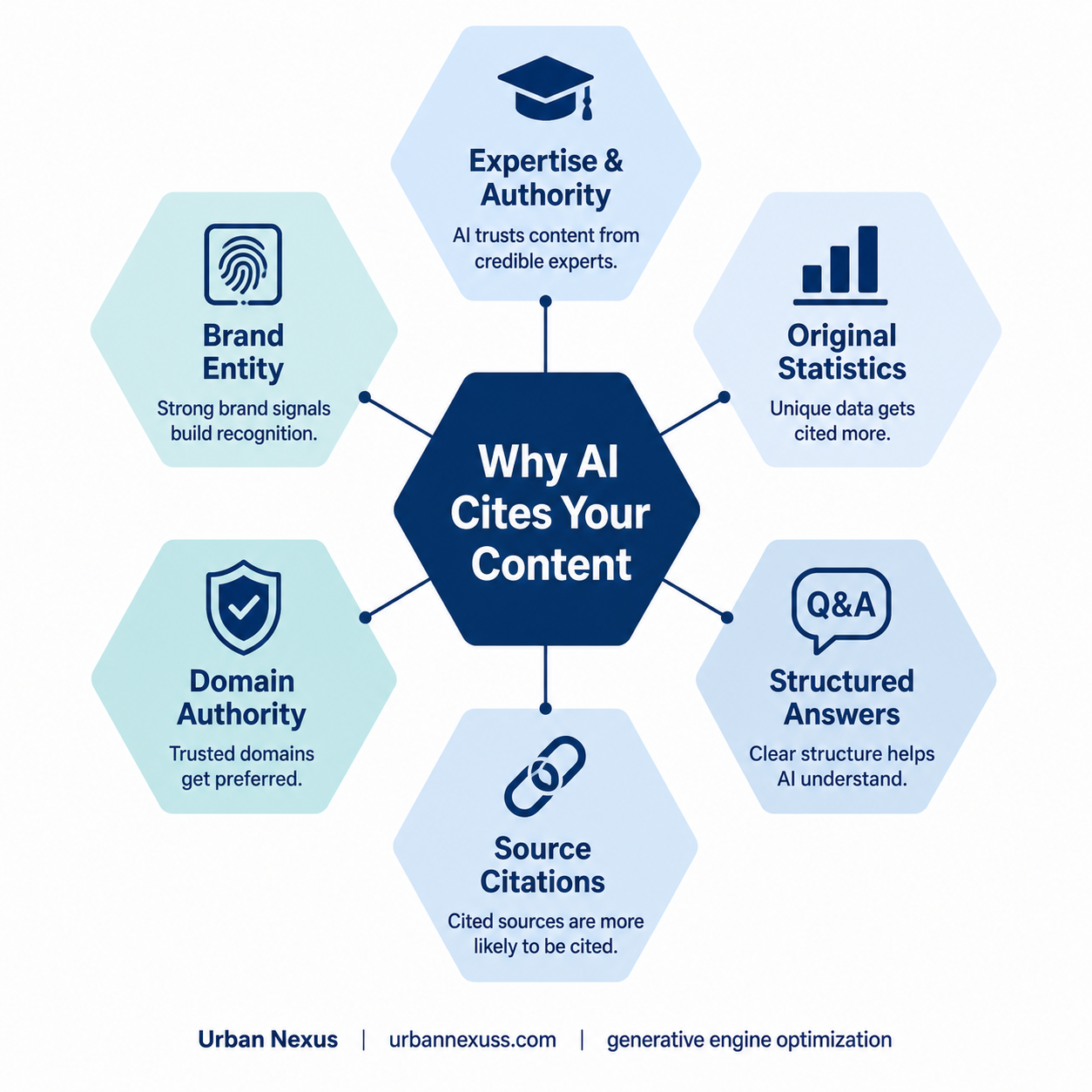
AI systems don't cite randomly. These 6 signals determine whether your brand makes the cut.
The 6 GEO Citation Signals
What Makes an AI Choose Your Content as a Source
Understanding these shifts in how you write, structure, and distribute every piece of content
Expertise and authority — specialised, practitioner-authored content is cited more than broad generic guides
Quotable statistics — content with verifiable data is cited 35–40% more frequently (Princeton/Georgia Tech, 2024)
Structured, direct answers — FAQ format and 'What is X? X is...' openings are highly parseable by LLMs
Third-party citations — citing credible sources makes AI more likely to cite you in return
Domain authority — strong backlink profiles increase the reliability of RAG retrieval
Brand entity recognition — consistent brand presence across platforms makes AI reference you by name
5 Actions to Start Optimising for GEO Now
GEO is a reorientation of work you are likely already doing — not a complete rebuild.
1. Add a Quick Answer box to every blog post
Open every piece of content with a 2–3 sentence direct answer to the primary query. This format is scannable for humans and parseable for AI — it also improves featured snippet rankings as a bonus.
2. Build a comprehensive FAQ infrastructure
FAQs are GEO gold. Add a detailed FAQ section to every service page and blog post, structured with FAQ schema markup. For Urban Nexus, this means directly answering: 'How long does SEO take in India?' 'What is the ROI of digital marketing for Indian SMBs?' — with data.
3. Establish brand entity consistency
Ensure your brand name, description, and contact details are identical across your website, Google Business Profile, LinkedIn, and Crunchbase. This is how Google's Knowledge Graph — and LLM training data — recognise you as a trusted entity.
4. Publish original data
A survey of 50–100 Indian business owners, published with methodology, creates citable statistics that AI systems will reference. Case study results with specific numbers ('40% lead increase in 90 days') become indispensable data points no competitor can replicate.
5. Monitor your AI citation presence
Weekly: Query your target keywords in ChatGPT, Perplexity, and Google AI Overviews. Screenshot results. Monthly: Search for your brand name directly in each AI platform. You cannot optimise what you cannot measure.
Quick GEO Readiness Score
Does your content open with a direct answer? Do all service pages have FAQs with schema? Is your brand entity consistent across all platforms? Do you cite external sources? Do you have the original data or case-study statistics? Score 4–5: GEO-ready. Score 2–3: In progress. Score 0–1: At risk.
The GEO Readiness Checklist — How Does Your Brand Score?
Run through this checklist to assess your current GEO readiness. Each item is a specific, auditable signal.
✓ Content opens with a direct, question-answering format ('What is X? X is...')
✓ Every blog post has a 'Quick Answer' box in the first 100 words
✓ FAQ sections exist on all service pages and key blog posts, with FAQ schema markup
✓ Author bylines with credentials and LinkedIn profiles appear on all content
✓ Content cites at least 2–3 credible external sources (reports, studies, data)
✓ Original statistics or case study data appear in content (specific numbers, percentages)
✓ Brand entity is consistent across: website, GBP, LinkedIn, Crunchbase, directories
✓ Domain authority is above 30 (checked via Ahrefs or Moz)
✓ Content addresses India-specific context, data, and use cases where applicable
✓ You actively query your target keywords in ChatGPT and Perplexity at least once per month
✓ Guest articles or press mentions from credible third-party publications exist
✓ Your About page clearly defines your brand entity: who, what, where, why, and different
Score your results
10–12 items: GEO-ready — you are ahead of most Indian agencies. Now focus on content depth and citation monitoring. | 6–9 items: In progress — prioritise FAQ infrastructure, author credibility, and original data creation. | 0–5 items: At risk — your content strategy needs structural GEO work before AI search erodes your organic performance further.
A Practical GEO Roadmap for Indian Brands in 2026
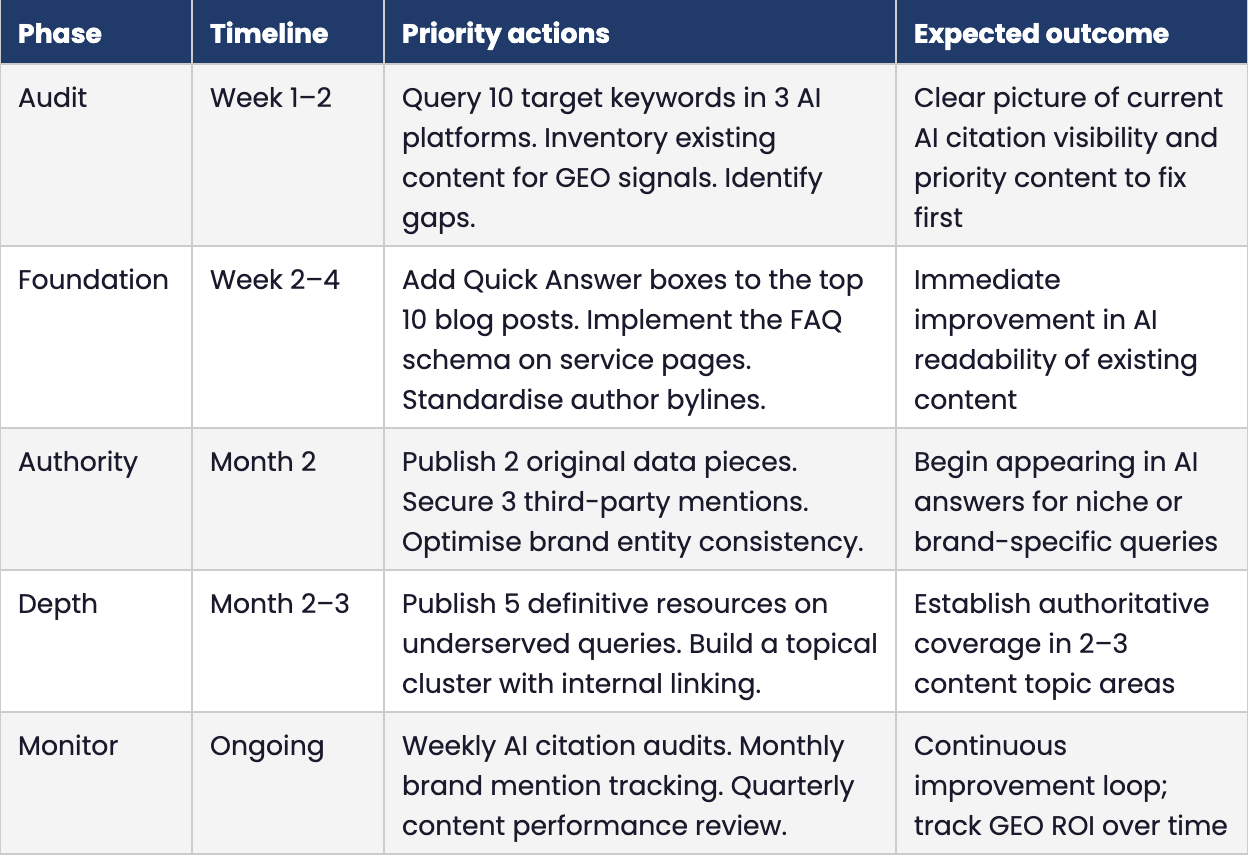
Most brands cannot overhaul their entire content strategy overnight. This phased roadmap is designed for practical implementation:
Is Your Brand Invisible to AI Search?
Urban Nexus runs a free GEO readiness audit for Indian businesses — we check your citation visibility across ChatGPT, Perplexity, and Google AI Overviews and identify the fastest wins.
→ Book your free GEO audit at urbannexuss.com/contact
Is Traditional SEO Dead?
No. Google still processes over 8 billion searches per day. But the search journey has changed: users increasingly begin with AI (informational intent) and move to Google's organic results when ready to act (transactional intent).
Top-of-funnel content needs GEO optimisation — it is increasingly consumed via AI
Bottom-of-funnel content still needs SEO — this is where AI hands off to organic search
The brands that win in 2026 build both in parallel, not one at the expense of the other
Urban Nexus's framework
GEO for top-of-funnel AI citation → SEO for mid-funnel organic ranking → Conversion architecture for bottom-of-funnel decisions. Each stage feeds the next. Optimising only one creates a leaky funnel at the others.
The Window Is Open — But Not for Long
GEO is the most significant content strategy shift since mobile-first indexing. Sources that establish AI citation authority early are far harder to displace later — LLM retrieval systems have inertia.
The window is especially wide for Indian brands because almost no one is actively optimising for GEO in this market yet. The opportunity is measurable and available right now.
Your starting point this week:
Query your top 10 keywords in ChatGPT and Perplexity — note where you appear
Add a Quick Answer box and FAQ section to your 5 most-visited pages
Standardise your brand entity across the website, GBP, LinkedIn, and Crunchbase
Identify one question in your niche AI can't answer well — publish the definitive resource
GEO is not a silver bullet. It is a discipline — one that compounds over time as your content authority grows, your brand entity strengthens, and your citation frequency increases. The earlier you start, the harder it becomes to challenge your position.
At Urban Nexus, we have been building GEO frameworks for our clients since the early days of AI search. Our GenAI-first approach means this is not an add-on for us — it is how we think about content strategy by default.
Ready to Become the Brand AI Recommends?
Urban Nexus helps Indian businesses and B2B brands build full-funnel search presence — SEO + GEO — designed for the way people search in 2026.
→ Start with a free strategy call — urbannexuss.com/contact